Online stores and shopping apps that carry the brand.
From a Shopify store built around a drop to a native app for repeat customers — Arabic-first where your customers are, on commerce platforms that already handle checkout, tax and fulfilment.
How this business actually runs.
Most stores don’t need custom commerce plumbing. Checkout, payments, tax and fulfilment are solved problems on platforms like Shopify. What isn’t solved is a store that looks and reads like the brand — in Arabic as well as English — and keeps customers coming back.
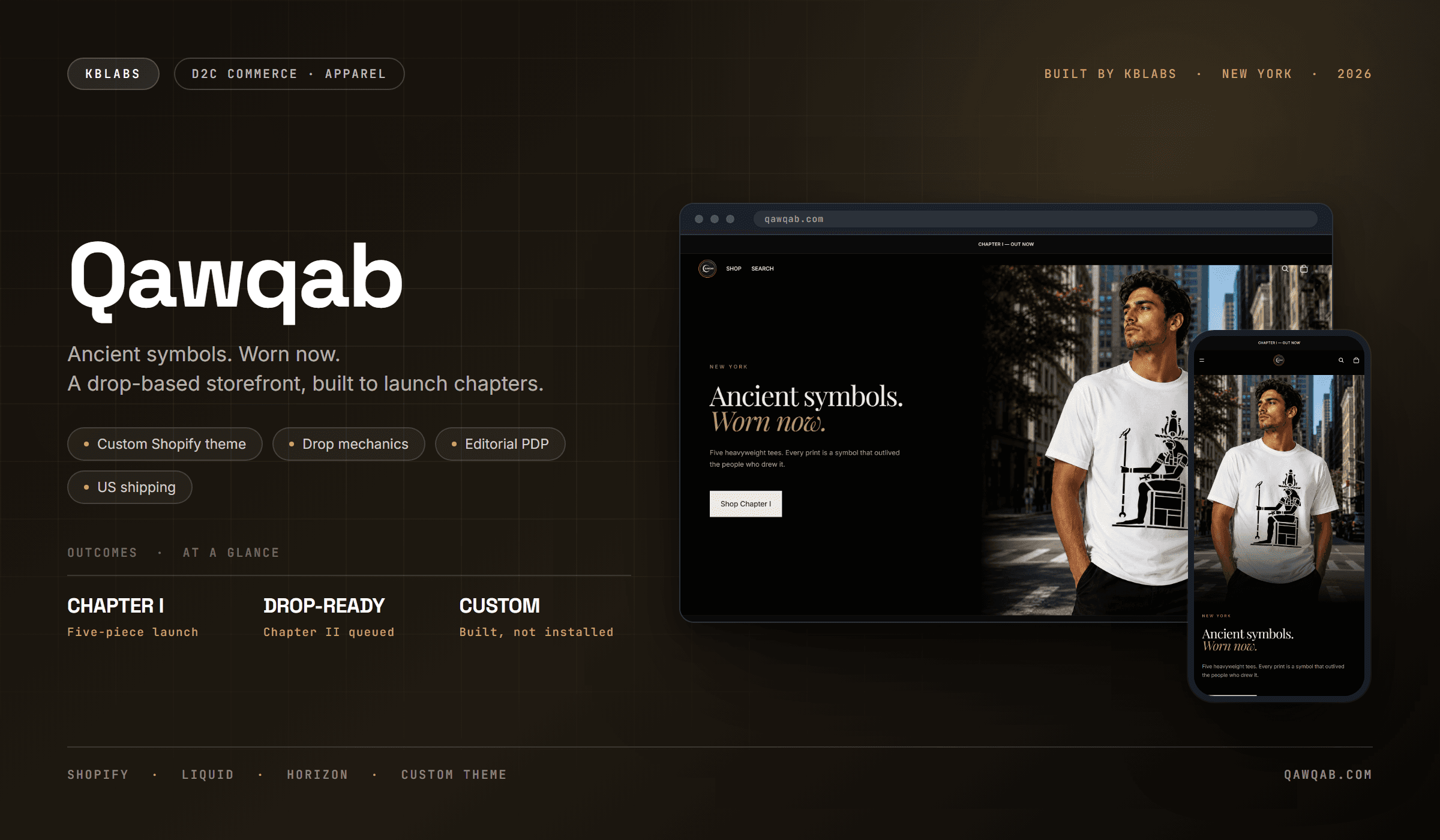
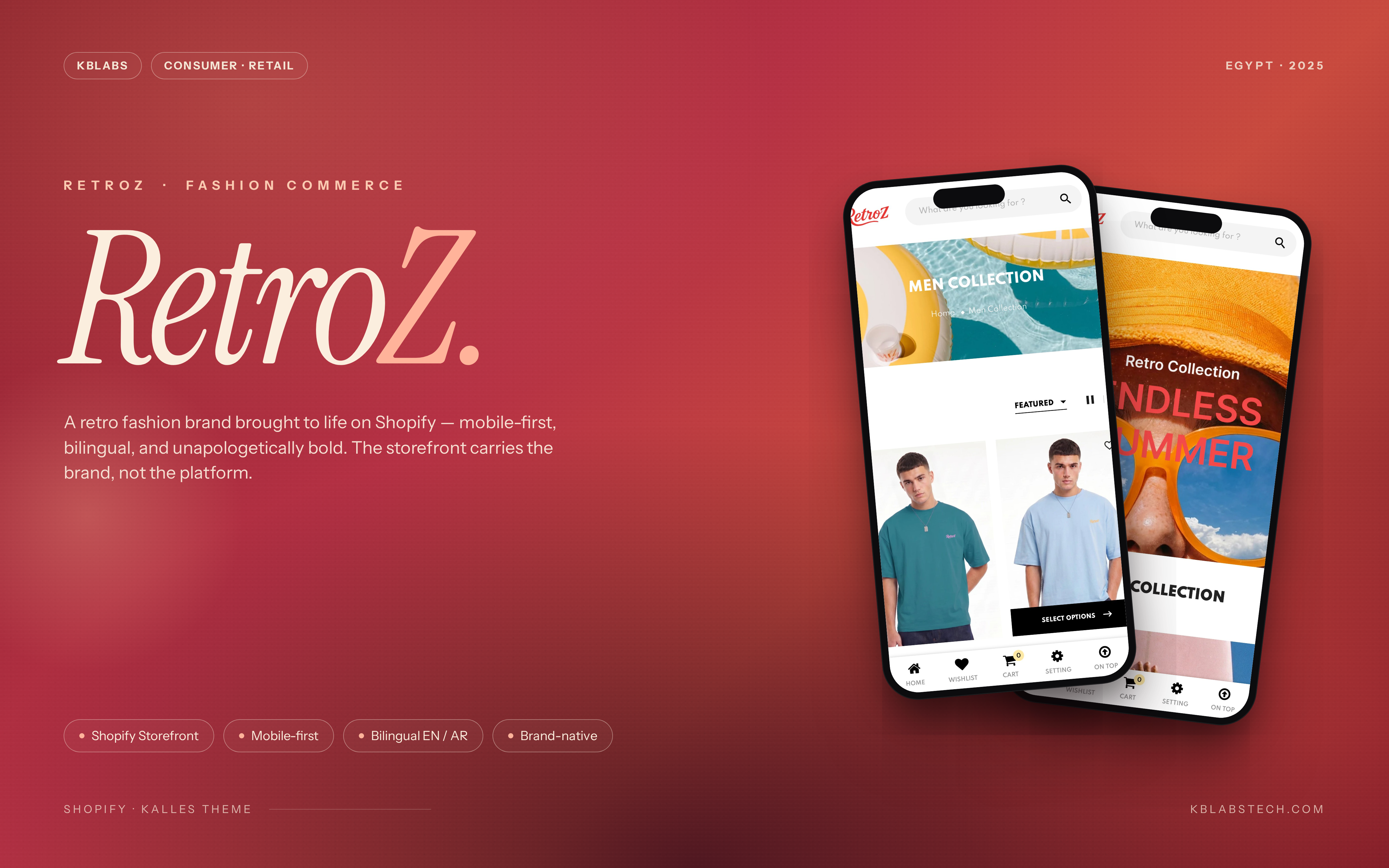
Qawqab, a New York apparel label, runs on a custom Shopify theme we built on the Horizon foundation, structured around chapter drops so launching the next one is a content change, not a rebuild. For Retro-Z, a fashion brand, we replaced a generic app wrapper with a native app that carries the brand: drop countdowns, restock alerts and checkout inside the app.
We’ll tell you when a well-chosen theme is enough, and when a custom build pays for itself.
The systems this business needs.
Custom Shopify storefronts
Every surface the customer sees is designed for the brand; inventory, checkout, payments and tax stay on Shopify’s managed rails.
Native shopping apps
iOS and Android apps on top of your existing store through the Storefront API — one catalogue, one checkout, a much better experience than a wrapper.
Drops, pre-orders & waitlists
Countdowns, “notify me” for sold-out sizes, and waitlists that turn the next release into an event rather than a quiet restock.
Arabic-first stores
Full RTL, Arabic product copy written for the market, search that copes with spelling variants, and checkout in the customer’s language.
Repeat-customer features
Wishlists, bookmarks, re-order and push campaigns — the reasons a customer opens your app instead of a marketplace.
Operations behind the store
Connections to your stock system, point of sale and shipping couriers, so online orders don’t get re-typed.
What’s different in Egypt and the Gulf.
- Cash on delivery is still a large share of orders in Egypt — checkout, confirmation and returns have to be designed for it.
- Local payment gateways and buy-now-pay-later providers, alongside cards and wallets.
- Arabic and English stores for the region, English-first stores for the US — the same team builds both.
- Instagram and WhatsApp drive much of the traffic, so product pages are built to be shared and to load fast on mobile.
Related work we shipped.
What gets asked before signing.
- Should we use Shopify or build a custom store?
- For most brands, Shopify with a custom theme: you get a reliable checkout, payments and tax handling, and every customer-facing surface still looks like you. A fully custom store makes sense when your pricing, ordering or catalogue logic doesn’t fit a platform — B2B price lists are the usual case.
- Can you build an app for our existing Shopify store?
- Yes — that’s what we did for Retro-Z. The app reads your catalogue and checks out through Shopify’s Storefront API, so there is one source of truth for products, stock and orders.
- Can a Shopify store work properly in Arabic?
- Yes, if the theme is built for it. Right-to-left layout, Arabic typography and translated checkout need to be designed in, not added with a translation app afterwards.
- How long does an online store take?
- It depends mostly on how custom the storefront is and whether a native app is part of the first release. Our project estimator gives a range for your scope in a minute — pick “Online store”.
Have an RFP? Have an idea? Let's build it.
We reply to every inquiry within one business day. Tell us about your project, timeline, and what success looks like.